

Nicholas Burrowes: Everybody's Got an Audience Plan Until They Get Punched in the Mouth
Right now, as I write this, Mailchimp emails me saying our latest email has been opened by 30% of recipients. The dashboard shows 9%. My personal Gmail account says I opened it on delivery (I didn't). Five days later when I actually opened it and clicked links, none of this was recorded on the dashboard.
Then I noticed all my historical reporting had been drastically amended downward. Campaign data I'd supplied to clients, now showing completely different numbers.
The metrics we'd universally been relying on simply stopped working reliably.
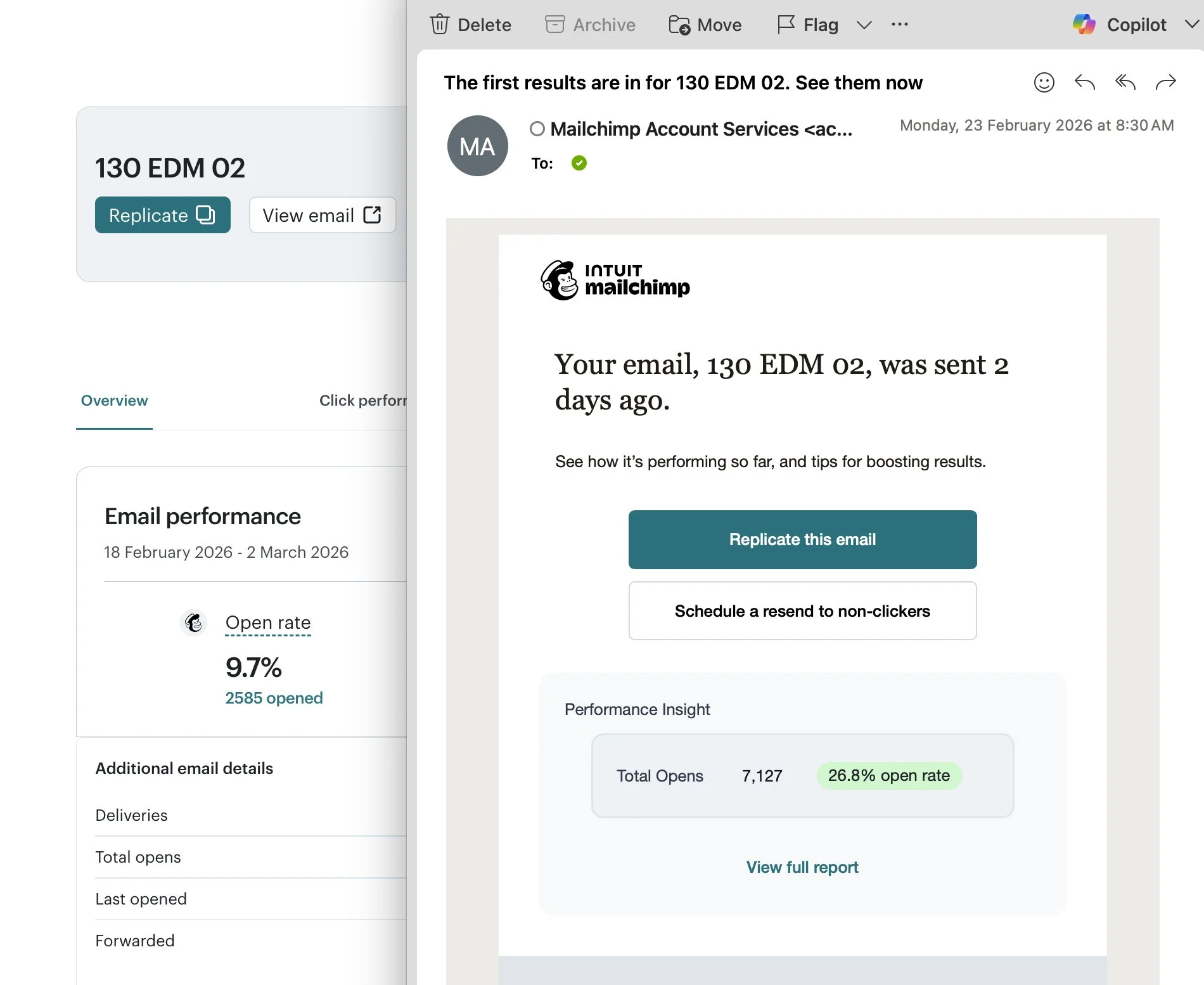
Above: Same campaign, two different reports
The Pattern
This isn't the first time.
Everyone built audiences by pouring years into content calendars, community management, follower growth. We were told to "build your community" and "own your audience."
Then Facebook organic reach went from 16% to 2%. Suddenly you had to pay to reach people who'd explicitly chosen to follow you.
That 100,000-follower Instagram account that was once considered an asset? If engagement is running at 0.1%, it still has value - but not the value the follower count suggested.
Email was supposed to be different. First-party data, direct relationships, no algorithm between you and your audience. The phrase "own your list" came to encapsulate the belief that first-party data could give marketers direct control, insulating them from platform whims.
Except email isn't exempt from platform dynamics. ISPs — Gmail, Apple Mail, Outlook — control delivery, filtering, and tracking just as completely as social platforms control reach.
The timeline:
Apple Mail Privacy Protection (2021): Pre-loaded images to protect privacy. Metrics looked great, but measured Apple's bots, not humans.
Gmail changes: Deliverability became inconsistent. Opens and clicks increasingly unreliable.
Microsoft/Outlook adjustments: Increased filtering, more deliverability challenges.
When The Ad Contrarian, Bob Hoffman, started calling out digital metrics years ago, his criticisms sounded excessive at the time. In hindsight, watching email metrics degrade, he was both prescient and reasonable. (NB: Bob’s back, BTW)
What the Metrics Actually Hid
Here's what the collapse reveals: we misclassified what these channels actually do.
The metrics didn't lie about email's value, rather, they lied about what kind of value it was. High open rates looked like reach at scale. But they were measuring familiarity, not discovery. Engagement with people who already knew you, not introduction to people who didn't.
When measurement degraded, it didn't destroy value. It removed the illusion that retention scale equals market reach.
We'd been using retention metrics to justify growth strategies.
Your email list gives you reach to people who already know about you. Your Instagram followers are people who already found you. These are powerful retention tools—but they were never discovery tools.
At some stage, many businesses started thinking they didn't need media companies anymore, particularly SMEs or those with less resource. They had their own audience: followers, subscribers, direct access. The dashboards showed impressive numbers. Why pay for reach when you already owned it?
The measurement theatre made it all look the same.
We sell email and social products. We've benefited from those same dashboard numbers. We've used open rates in client reports. When the metrics degraded, we had to have uncomfortable conversations about what we'd been measuring all along.
But here's what we know works: we run client competitions through email that consistently generate 2,000-3,000 entries. If a retail sale campaign nets the sale of two premium pieces of furniture, that is massive ROI. That's measurable, verifiable behaviour.
We also sell access to our email database to advertisers. But here's the distinction: our audience trusts the publication. When we send them something, it carries editorial context and credibility we've built over two decades. That's different from a brand emailing its own list: ours delivers both retention value (our existing audience) and discovery value (introducing brands to people who trust our curation). Most businesses only have the first part.
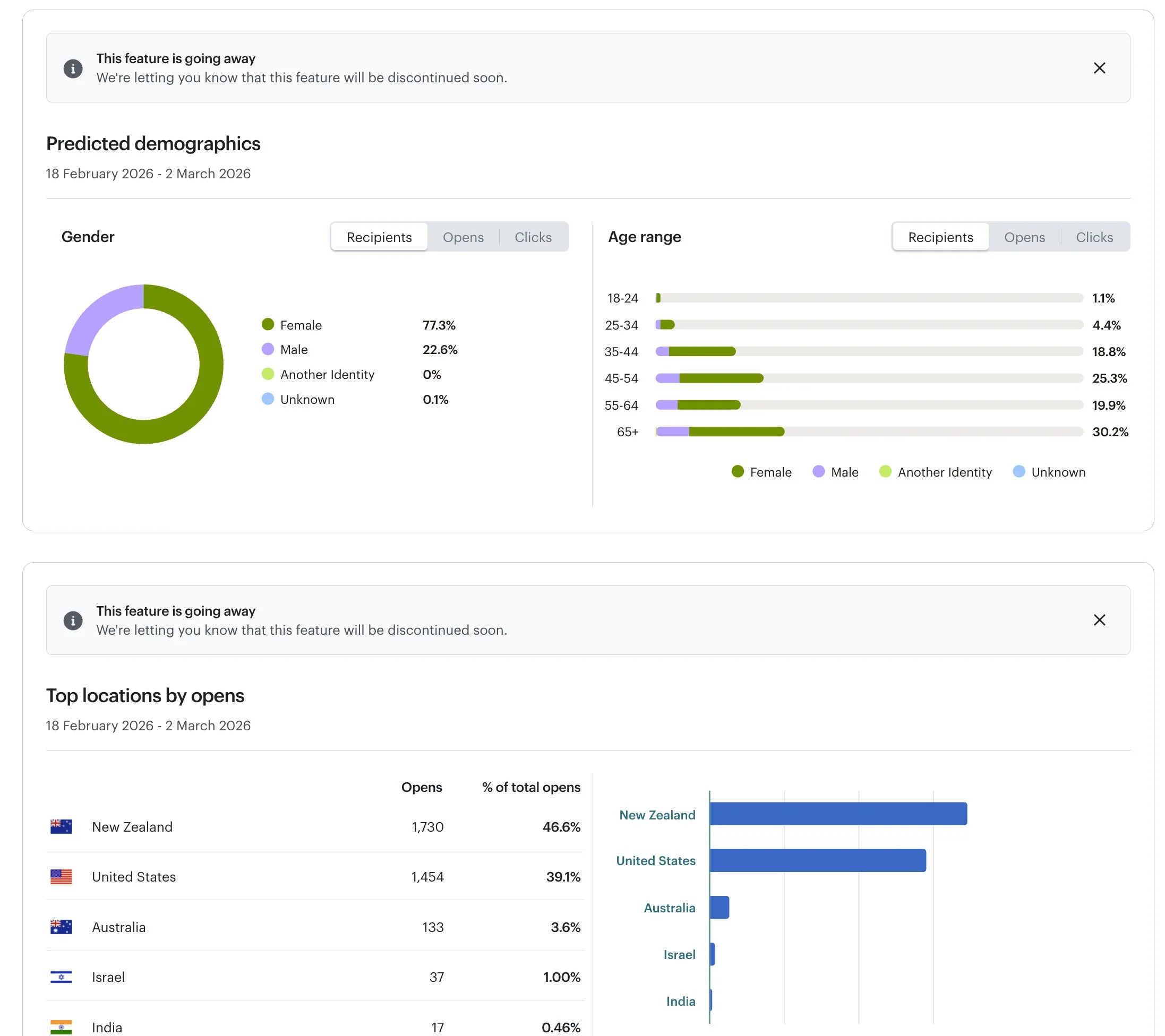
Above: once lauded metrics being phased out
What Actually Creates Growth
Growth requires three things your database can't deliver:
Reach to new people. Not the people who already signed up. People in the consideration phase for your category who don't know about you yet.
Context. Your message appears alongside related content in a trusted environment. Someone reading about kitchen design is mentally prepared to consider kitchen products. Someone scrolling Instagram memes cross-eyed at 11pm is not. A $20,000 sofa does itself no favours sitting in a feed next to ads for dog food or Temu knock offs in a social feed.
Transferred credibility. The media channel's editorial or content standards lend authority to your message. You're not making claims in isolation - you're featured in a trusted context that signals quality and relevance.
Yes, discovery can happen inside platforms through paid promotion. The risk is relying entirely on environments you don't control—where costs rise, algorithms shift, and access is conditional on continued payment.
Owned channels excel at retention. Scaled discovery requires distribution beyond your own database. These aren't competing, they're complementary. The problem was confusing one for the other.
The metrics just hid this structural reality. Of course open rates degraded—ISPs prioritized user experience over marketer convenience. Of course organic reach dropped—platforms realized they could charge for what they'd been giving away. The incentives were always misaligned. We just couldn't see the truth behind the impressive numbers.
What's Actually Left
Strip away the broken metrics and what remains?
Active signals still work: someone clicked to enter a competition, filled out a form, replied to an email, or spent ten minutes reading. These are intentional behaviours you can verify.
What no longer works are passive proxies. Opens, impressions, reach—these were always weaker indicators than we liked to admit. We just chose to ignore that because the dashboards felt authoritative and comforting, like an ECG tracking a patient, the beeps and graphs gave the illusion everything was fine.
Mailchimp says 280 people opened your email. Your phone rings twice. Which number counts?
Business outcomes still matter: Did someone reply? Did someone buy? Did revenue increase? Did brand perception rise or fall? That's what always mattered. The metric degradation just stripped away the distraction.
-
Everyone had an audience plan until they got punched in the mouth.
Social media threw the first hard jabs—organic reach collapsed. Email just threw the upper-cut—the measurement became increasingly unreliable.
Here's what both punches revealed: retention and discovery are different categories. The measurement Kabuki just hid that truth.
Media gives you reach to people who aren't considering you yet. It gives you context—your message appears where people are receptive. It gives you transferred credibility you can't manufacture alone.
Your email list is valuable. Your TikTok following matters. But neither replaces the work of reaching new people in contexts where they're ready to listen to what you have to say.
The next platform will promise the same thing. Don't stick your chin out this time.
Nicholas Burrowes is General Manager of The Pluto Group and board member of the Magazine Publishers Association (MPA).
Sign up to Homestyle intelligence updates
Recent Stories by Nicholas Burrowes
-
Who chose this environment for your brand?
Five minutes on Facebook Marketplace is enough to find household brands advertising in some alarming places. -
Everybody's Got an Audience Plan Until They get Punched in the Mouth
How brands lost control of their audiences - and mistook dashboards for certainty -
The Channel that Endured:Why Print May Outlive the Website
As access to audiences becomes less certain, control is becoming the more valuable asset -
Letting the Defender do the Work
Experiencing the full Land Rover Defender 2026 range in Taupō. -
Esperienza Ferrari on Ice 2025
Drifting the 12Cilindri across snow-covered alpine fields of the Southern Hemisphere Proving Grounds. -
On the Trail with Toyota
Exploring the West Coast’s wildest 4x4 terrain in the new Prado Hybrid. -
The Defender Journey with Land Rover
Traversing the rugged and picturesque high country of Central Otago in the Defender, and savouring the luxury of The Lindis.